Thursday, 1 August 2013

More to do...

After a busy spring period summer is a useful time on the nursery to take a breath. Most of the young plants have been potted and are growing away in their tunnels or outside, and in a few cases the fastest rooting plants are making their way slowly but surely towards the sales area. Summer is a time to get some real horticulture in, pruning, training and staking plants as necessary, as well as watering and using liquid fertiliser (including the amusingly named 'fertigation', that is applying feed via the drip irrigation to trees etc.).

Adding a complex task to the summer schedule is unwise, especially if you're short staffed. Nonetheless there are some things where the pain is worth the rewards, and one such job is potting shrubs sent from New Zealand.

But why New Zealand, and why is this a problem? In New Zealand there is a rather excellent nursery called Stepping Stones, and they produce large Acers and Magnolias (and possibly other things too). In terms of the product they are world class, producing good sized plants at a reasonable cost. For those 'in the know' it is easy to recognise a Stepping Stones 'rod' in a garden centre or nursery- the distinctive straight stem with horizontal branching can be spotted from quite a distance. The advantage to the gardener is that fairly large specimen trees can be bought for less than a UK grown plant of the same size would cost.

The problem comes from the shipping time; plants are sent dormant and bare rooted in July which is winter in New Zealand... but is summer in the UK! The battle for any UK nursery is to allow the plants to have a 'spring' in August, grow a little and become established, and then move safely into autumn with the rest of the deciduous stock. Successful overwintering of the new stock relies on the skill and experience of the growers, regulating the moisture of the compost all winter.
You can see why they nickname these boxes 'coffins'!
Potting quickly is vital, the delicate roots won't stand being exposed to dry air for long. Plants are carefully unpacked and sorted into their varieties; each plant is taped with a code that relates to the name of the plant. Once sorted, each plant is potted up into the appropriate size pot, usually 7.5L or 10L. 
Picking out the trees from the 'coffin'...

... and counting them in their batches.
Tape with a code for each variety...

... best to write your own label too!
Quickly sorting and potting the plants is only a tiny part of the struggle- now here comes the tricky bit! Allowing bare rooted Acers and Magnolias to be subjected to summer heat is not a good idea; the plants need to gently ease themselves into growth, rather than exploding into full growth. Plants need a cool and shaded space, under plastic, with a very good air flow. We found a spot in one of our tunnels where the new plants are sheltered by large specimen Acer griseums, Acer davidiis, and a few specimens of Cedrus atlantica 'Glauca'. The other side is open to the elements and this should allow good air circulation- if the weather takes a turn for the worse we might have to choose another spot!
 
Potted and set out in the tunnel.
To help reduce stress on the Magnolias the suppliers sent a bottle of a 'Sticker' which gets mixed in water and sprayed over the new shoots. I believe it works by providing a protecting film over the fleshy stems which seals moisture in. Can't say if it's effective or not because I've never seen what happens to a Magnolia that hasn't been sprayed- the opinion seems to be that if Stepping Stones sends it with their products then it probably works!
Free gift- 'sticker'.

For now the plants are settling down to their new surroundings and should leaf in the next fortnight or so. These plants will probably be ready for sale in 18 months or so, so it's a long process, but should be worth it in the end. Sorry if you're hoping for hot and dry conditions for your summer holidays, a lot of UK nurseries will be hoping for cool and dull weather!

Friday, 21 June 2013

No, Puyas are NOT carnivorous!

Sheep farmers needn't worry about a menacing plant at RHS Wisley attacking their sheep! First, read the original story here: http://www.bbc.co.uk/news/uk-england-surrey-22967160

Puyas are terrestrial bromeliads native to fairly arid areas of South America, with most originating from the Andes. They are notorious in specialist gardening circles for their stiff and vicious backward facing spines that can easily ensnare an unsuspecting hand. Interestingly Puya raimondi holds the record for the tallest flower spike of any plant, a staggering 32ft (10m) tall!

But are they carnivorous? Despite disagreements from anyone who has lost their own blood to this genus, they are not. Carnivorous plants are specifically adapted to lure in their prey, usually with the promise of tasty nectar, but then trap the prey in sticky goo (e.g. Drosera), pitfall traps (e.g. Sarrecenia) or in a fast moving trap (e.g. Dionaea, the Venus' Fly Trap). There are a couple of disputed carnivorous bromeliads too, Catopsis and Brocchinia, but these are epiphytic 'tank' bromeliads and are very different from Puyas.

Stories about Puyas feasting on sheep are probably exaggerated- no doubt sheep occasionally get trapped in the huge rosettes of Puyas, and cuts to the face from the sharp spines are probably fairly commonplace (after all sheep aren't all that bright!) but there's nothing really to suggest that the Puyas are munching on fresh lamb!

I originally saw this story in the members magazine of the Eden Project in Cornwall, although it might have come second hand to them. As my friend showed me the article I was astonished to read these claims of carnivory being peddled by a so-called educational establishment. To find this dubious information being passed on by the RHS is doubly disappointing, but I suppose the promise of a rare and macabre plant will do no end of good to their visitor figures, but there's one thing puzzling me; Puya chilensis is a rare plant with vicious spines that seldom flowers outside the mild gardens of Cornwall, but when it does it produces a flower spike 10ft (3m) tall... why isn't that impressive on it's own?!

Wednesday, 19 June 2013

8 Urban Myths In Gardening

With so much information around in gardening it's no wonder things sometimes don't come out quite right. Here are eight urban myths in gardening

Agapanthus need to be pot-bound or they won't flower
Nope! Agapanthus flower very well in the garden, large clumps often bearing dozens of fabulous flower heads for weeks in the summer. The secret to success with Agapanthus is good life- good rich soil, enough water during the summer (although not too much during the winter) and plenty of sunshine. The myth that Agapanthus need to be pot-bound probably stemmed from a misunderstanding; Agapanthus flower better when they've made a clump- dividing your Agapanthus into small chunks won't help it flower. Plant your Agapanthus out in the right spot and then leave it!
Perfectly happy in the garden- Agapanthus inapertus 'Sky'

Nerines want to bake in hot, dry and poor soil
Nope! Not sure where this has come from; Nerines are happiest in good garden soil with good drainage (but not dust dry!) and with plenty of sunshine, here they will bulk up beautifully. The larger the bulb the better the flower display. This myth might have come from Holland, where bulbs are treated with hot water to stress them into flowering when the bulb is too small- this is all well and good for bulb merchants, but in the garden it is better to focus on building up the bulbs naturally for long term benefits.

You should water your plants every day until they're established
Hmmm, no.... Although this is rooted in common sense, it is generally reckoned to be better practice to water your new plants really well 2-3 times a week (normally twice a week, three times a week if it's very hot and dry) instead of a little and often. The sense behind this is that a few good soaks encourages the plant's roots to grow down and search for water, whereas watering a little and often encourages roots to stay near the surface (and makes the plant more susceptible to stress during dry weather).

Shallow pots drain better
NO! Garden books will tell you to put a nice layer of crocks (bits of broken pots/flat stones) at the bottom of the pot for drainage, but in fact current thinking is that a drainage layer at the base of the pots might do more harm than good. Compost is much like a sponge; if you saturate a sponge and then let it drain you will be left with a saturated layer at the base of the sponge, while the top has dried out. The same happens in a pot, but the drainage layer pushes that layer of saturated compost closer to the roots. If you want to get your compost to drain then pick tall/deep pots which keep the saturated layer of compost further away from your plant's roots. Often if you remove a nursery grown plant from it's pot you will find that the roots aren't quite as keen to fill the bottom centimetre or so of the pot, and it's because of this layer of saturated compost!

Add lots of grit to improve drainage on clay soils
Nope! This old wisdom can spell disaster- clay soils are made up of tiny particles and these mix with the grit, and in dry weather this layer stiffens into what could only be referred to as a natural concrete! Much better to add plenty of good organic matter to the soil, and this will improve soil structure.

Only native plants are good for insects
Insects need a ready supply of nectar from flowers, and the best way to provide plenty of food for native insects is to fill your garden with plants that will flower for as long a season as possible, and these are nearly always non-native species*. Try to make sure there's plenty in flower in spring and autumn for the early emerging insects and those late to hibernate.
Early flowering and good for bees, but this Mahonia 'Lionel Fortescue' is not native!

Plant snowdrops in the green
Nope. This old hunk of horticultural 'wisdom' is probably well enough known to have become 'ancient gardening lore'! It is, however, of dubious accuracy. Like all bulbs, snowdrops (Galanthus) are best divided when dormant, in this case in August. However it must be said that Galanthus bulbs have thin skins and can dry out fairly easily if not handled carefully; with this in mind you are probably best avoiding dry bulbs in bags from the garden centre! Lifting bulbs 'in the green' (when in full growth) is more convenient to commercial growers who like to lift and bundle Galanthus from the open ground, but this does cause the bulbs a degree of shock from the disturbance. Gardeners really should try to lift and divide their bulbs in August, making sure that bulbs are planted again very quickly, and the bulbs will grow away healthily in spring.
Galanthus 'Straffan'- please divide when dormant!

Alstroemerias must be grown in pots
Hmmm, well possibly. Alpine species and tender varieties need to be in pots out of necessity, but the garden hybrids really are much better in the ground! Alstroemerias like good deep garden soil with good drainage (see the bit about drainage in pots above). In pots plants can easily get overcrowded and pot-bound, as well as needing a lot more feeding and watering. Also plants in pots are more susceptible to damage by frost being able to get into the too area from all sides. I would suggest assuming that any Alstroemeria grown in a pot is tender. In the garden, however, Alstroemerias have ample soil to grow in, are less susceptible to drying out and are better protected from frost. For best success it is wise to give your Alstroemerias a thick layer of a dry mulch (bark chips would be ideal) for the first couple of winters while your plant gets established.
Alstroemeria 'Inca Exotica'
*Conserve native plants for their own sake!

Sunday, 26 May 2013

My crime against horticulture

... and the pitfalls of living in rented accommodation.

As I write literally hundreds of men and women are dismantling the 100th Chelsea Flower Show. Plants and hard landscaping materials are being loaded onto trucks to be taken away and resold or, in the case of a lucky few, reassembled permanently elsewhere. This year we have seen a fascinating range of gardens from the great and the good of garden design, but here, in a quiet corner of Cornwall, a crime has been committed.

Let me fill you in a bit; my house shares a common lawn with my neighbours. There's a wooden fence that separates the lawn from a short drop to our parking spaces. Both houses have their own gate, but there is no division at the front of the two houses.

My neighbours decided that they wanted to grow runner beans and a few herbs along the fence line in front of their house, which is fair enough. Unfortunately this left a messy strip in front of mine, too tricky to mow between the fence posts. Today I got sick of this and decided to sort it out, so I dug over the area and planted a few things. No problem?

In order to match in with the 'border' next door I kept the front of the border in line with the front of theirs. The only problem is that their border is barely a foot (30cm) deep!

Urgh, look how thin this is...
Yes, I have created a narrow border along a fence line. I'm not proud, in fact I'm ashamed- this goes against every design principle there is!

Not proud

 Why, you may ask, don't I make my planting area bigger? This is where the challenges of gardening in rented accommodation come in. Firstly my neighbours like the grass so their grand children can run around in safety when they visit, which I can entirely sympathise with. Secondly, living in rented accommodation there is a fairly good chance that at some point I will leave and have to set things right, and the more I do to the space, the more time and money I will have to spend making sure that everything is set right when I leave. The incentive to indulge in serious gardening isn't really there.

I see this time and time again on the nursery; customers (usually young couples) come in looking for a  fast-growing shrub to screen something or make some impact and as cheap as possible because they live in rented accommodation and don't want to spend a fortune. I grow nearly all of my plants in containers (except the few things that have gone into my 'criminal border') so I can at least indulge my love of plants at home. This means a lot to me because living alone I have to watch every penny for rent and council tax etc.,  so tinkering around and watering my plants is one of my few easily affordable pleasures.

On the parking bay side of the fence things fare a little better; using deep window boxes bought from my local garden centre I have made a 'border' behind where I park my van. I dabbled with 'flowers' (bedding) mainly to keep criticism about my "boring plants" down, but now I've settled on a mix of hardy herbaceous plants. Best of all with each section being different I can swap them around and, within reason, make a new border!


The little green tufts are white trailing Lobelia for later in the summer
Maybe one day I will find good luck and be able to afford a house (either rented or with the immense joy of a mortgage!) with a proper garden, or maybe someone will decide that their small parcel of land is irritating and that they want someone to do something with it- both are unlikely! For now I must do the best I can with containers and put up with the shame of my 'criminal border'.

Thursday, 2 May 2013

Indulge yourself AND save bees!

The decline in bee populations has been in the news a lot recently. A combination of increased pesticide use, loss of habitat and difficult weather conditions, along with attacks by varroa mite have decimated bee populations. Anyone who grows their own food or knows about the world around them knows how important bees are, but what can gardeners do to help them?

Grow plants!

The best thing we can do is grow plants. Gardening. Good news I'm sure you'll agree.

It seems that most people's ideas of a bee-friendly environment is a traditional meadow, full of nectar rich native plants, but what if that's not the answer?

Native plants are great, but a long succession of nectar rich flower is what bees need,
and gardens can provide that
Firstly most of our native plants don't actually flower for very long. Bees will buzz around collecting nectar (and pollen) from perennial and annual flowers in hedgerows and meadows for as long as they are in flower, but what happens when those plants go to seed? Yes, keeping habitats for wildlife is important, but my point is that gardeners should use what they have to make life easier for bees, so these are my own suggestions:
  1. Pick plants with single flowers- if you can see stamens in the flower then the bee can get in and find nectar, so avoid frilly double flowers (or keep them to a minimum).
  2. Choose plants with a long flowering season- sometimes these will be old varieties, sometimes new modern varieties bred for a long season.
  3. Grow a diverse range of flower types, so that different species of bees, as well as other insects, can find flowers that are easy to feed from.
  4. Try to make sure that your garden has something in flower all year round! Not only will this make your garden rewarding and interesting for you but you will also benefit bees around at other times of the year. Bumble bees don't have a proper hibernation, so on a warm winter's day you can often see one flying around- Mahonias and Sarcococcas will provide much needed early nourishment and will give you winter scent and colour. Likewise hollies are surprisingly good sources of nectar according to a bee keeper I know!
  5. Choose garden trees wisely- no point in planting a tree pollinated by wind if you want to feed the bees! Choose 'Crab Apple' (Malus) or 'Cherry' (Prunus) trees and the blossom will help the bees no end! Don't forget that the blossom of eating-apple trees are also good, so maybe a self-fertile apple tree on a sensible rootstock would be the perfect tree for your garden?!
  6. Grasses are all wind pollinated, so don't fill your garden with them. Likewise your lawn is like a barren desert for hungry bees, so consider reducing the size of your lawn (or getting rid of it altogether) to pack more gorgeous plants in!
  7. Bees can fly up, so don't keep all your flowers at low levels- large shrubs or Clematis scrambling up into trees will still be accessible to bees. While we're on climbers, Ivy is a great source of nectar for bees too, so don't rush to get rid of it if you don't have to. Using vertical space is very important, especially in a small garden, so using vertical surfaces to grow flowering climbers is good for you and for the bees.
  8. Provide shelter- that 'leylandii' hedge you hate provides the perfect home to lots of insects, including bees. Although it doesn't provide them with food it will provide a nice dry place to keep out of bad weather. 
    Digitalis 'Illumination Pink'- a new variety AND good for bees!

    Pesticide use
    Keep pesticide use to a minimum- only use an insecticide if ABSOLUTELY necessary! Most of the time a background level of a pest species doesn't cause any problems, but sometimes there can be a population explosion (aphids are very good at this) and you find your plants being inundated. Usually vigilance is key; squash a small colony of aphid in spring and they won't be around to cause problems later on, and this approach saves you time and money. If you really must use an insecticide make sure that you spray early in the morning before beneficial insects are active. Only spray the plants that are infested. Also, given that neonicatinoid pesticides have been implicated in bee decline you really should avoid them- speak with a competent member of staff at your garden centre or nursery, and always read the label before using. By growing a diverse range of plants and not too much of one thing crammed into a space (not too many roses, for example) you seldom find problems with pests. Use nematodes to prevent Vine Weevil grubs from munching plants in containers instead of known-to-be-harmful neonicatinoids. Your beautiful garden is an ecosystem, and by encouraging insects to live in your garden you will get plenty of predator species that will pick off your pests- nice to sit and relax as nature takes away all of your problems! 

    Trachystemon orientalis- an underused plant which is very
    popular with bees in spring.
Essentially what I'm saying is that if you cram your space with flowers you can not only enjoy the benefits yourself but can also feed bees and other insects. Good, eh?!

Friday, 15 March 2013

Please don't put a brick through my window!

“So I was using a neonicotinoid...”

In a short time I doubt I'll be saying that again! At some point in the not-too-distant future the insecticide group known as the neonicotinoid group will be banned from use in Europe. This insecticidal group of chemicals makes up about 25% of the European pesticide market, so there is a battle being waged between the producers of this chemical group (who predictably claim that the environmental effects of their products are minimal) and anyone who understands the importance of beneficial insects, including (most famously) bees. As the neonicotinoid group is a broad spectrum insecticide it will kill any insect. Although the doses and application rates are aimed at damaging populations of small insects, it also has a knock-on effect on larger insects that collect pollen and nectar from the flowers of treated plants, including causing infertility and abnormalities in bees, and subsequently population decline.

I'm not going to enter into the issues around the neonicotinoid group here. I would like to draw your attention to a product...

This is Intercept. It is a neonicotinoid that is available solely to professionals who have a pesticide handling certificate (usually a PA1/PA6). It is manufactured by Scotts, who also make slow-release fertilisers, “Miracle Grow”, and various insecticides and herbicides.


Now before you lobby to have all Scotts products removed from sale because they [currently] make neonicotinoids, I would like to draw your attention to the label. 

 
On the side of the label it makes it absolutely clear that this product must not be used on any edible crops, or even compost that might be reused to grow crops for human or animal consumption. Fair enough, it's poisonous and has a residual effect. Let's look at the bottom of the label....

“HIGH RISK TO BEES. Do not apply to crops in flower or to those in which bees are actively foraging. Do not apply when flowering weeds are present.”

This particular bottle of Intercept was bought in 2008 and has a clear warning that there is potential to harm bees.

How does one company know that their product is dangerous to bees warn users 
while another (Bayer) continues to maintain that neonicotinoids are not harmful?

Neonicotinoids will be banned from use. Horticulture is better placed to cope with this than agriculture; neonicotinoids have almost already been replaced by a bacterial product to combat vine weevils in compost ('Met52') (as well as using nematodes if needed later in the growing season), Integrated Pest Management (IPM), better horticultural practices, and (if necessary) the remaining chemical products available to professional growers.

At work we seldom spray any stock in the tunnels or outdoors- birds and insects do most of the work for us- and maybe the occasional isolated batch might need a chemical treatment if a pest population is getting out of hand. We never routinely 'blanket spray' plants, even though we grow an enormous range and are always short on manpower- nature takes it's course and we intervene only if absolutely necessary. Most hardy stock nurseries run along similar lines.

So before I get a brick thrown through my window... why was a using a neonicotinoid product when I know about the dangers to bees? I had a very serious root aphid infestation on the root-balls of some large Pinus roxburghii. Ordinarily plants with such bad infestations of root pests would be disposed of, but throwing away rare pines that are already more than a decade old is not an option. Am I happy with my decision? Yes. Pines are pollinated by the wind, not bees, and there is no chance of beneficial insects being harmed by the use of this product on the pine- I assessed the risks and used the product legally. Once there is an effective drench for root aphid on non-flowering plants then the little bottle of Intercept at the back of the pesticide locker will become a thing of the past. More likely we will run out of Intercept granules and then it will be banned, but at least the Pinus roxburghii are safe.

Saturday, 2 March 2013

King of Spring; the Magnolia

When it comes to splendour of spring the Magnolia is king. Large gardens in the South West boast dozens of these magnificent trees, some early collections of Magnolia species are now around 100ft tall and in March and April their blooms stand out for miles around!

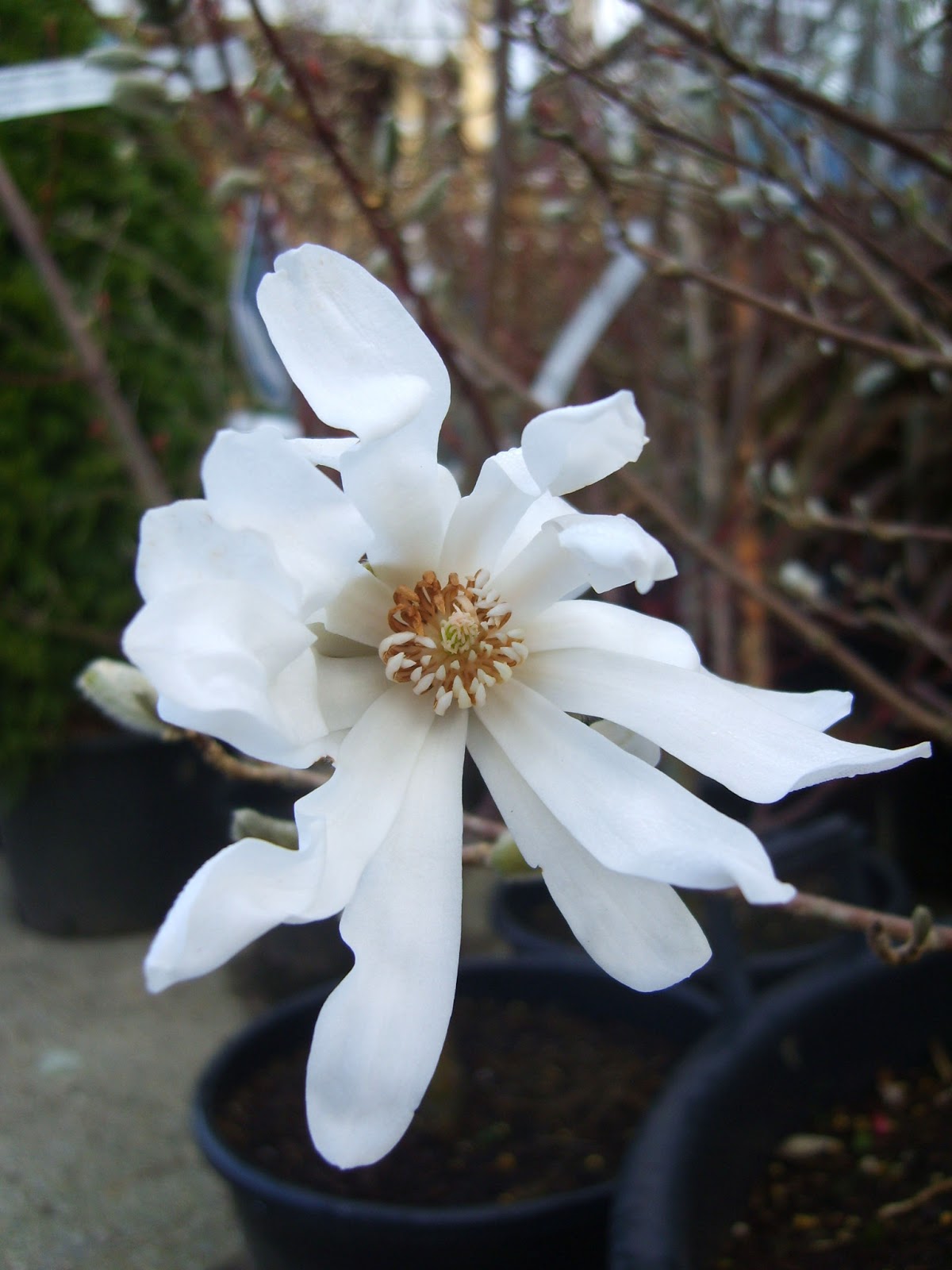
Magnolia stellata
The history of the Magnolia in cultivation is almost the same as that of the other stalwarts of the 'big house' garden, the Rhododendrons and the Camellias. In the early days (19th century) if you wanted a Magnolia you would have to sponsor a plant hunter, and these brave men would travel through the wilderness of the Far East in search of Magnolia seed. Then came the wait; Magnolias take an eternity to flower from seed, often somewhere between 20 and 50 years depending on species- growing Magnolias from seed really was an investment in the future of a garden! It is not unlikely that many of the men of wealth who sent the plant hunters out to far flung corners of Asia in search of seed never saw any flowers in return for their investment.

As time has passed Magnolia growing has moved on, and now you can buy some Magnolias in your local garden centre, although visiting a specialist for something special is very much worthwhile. Selection of clones, new propagation methods and good plant breeding have made Magnolias far more accessible to the general market, although Magnolias are still not cheap- they are not easy to graft and take a lot of time to make a plant good enough for sale, so it's unlikely that you will get a good Magnolia for less than £20, and even then it will be fairly small. Price isn't all that much of an issue really; most gardens will only have room for one or two of these trees, so it's a matter of finding the right tree for your budget.

In a previous blog post I mentioned the time-scales involved in breeding Camellias and how that affects their price and makes raising new varieties unattractive to nurseries. Magnolias have the same problem, but much worse! By the time a breeder's Magnolia hybrids are flowering in a stock field 20+ years may have passed since the cross was made and the seeds were sown. Once a new variety is selected from these seedlings (and indeed if a seedling is good enough to select) material must be taken and grafted onto rootstocks to create more propagation material. This process must be repeated for many years; each grafted plant will have to be grown for several years until it is big enough to yield more material for grafting. In order to yield enough material to make enough plants for release onto the market these plants must be grown on and on... Magnolia breeding needs time, space and patience!

Gardeners benefit well from this mammoth breeding task- modern hybrids are often superb, with excellent colour, form and flowering. Some varieties are well known, like Magnolia 'Susan' with it's deep purple flowers, and M. 'Star Wars' with it's open flowers and slightly pointed petals. 
Magnolia 'Susan' in bud
Magnolia 'Star Wars'


 Some flowers are just sublime, like this M. 'Iolanthe' which has a superb scent and enormous mouthwatering flowers.
Magnolia 'Iolanthe'
Some selections are superb for creating 'flower power', such as M. x loebneri 'Merrill', a very good alternative for Magnolia stellata (top).

Magnolia x loebneri 'Merrill'

For sheer beauty M. x soulangiana 'Picture' is awesome, as are some of the yellow Magnolia hybrids, like M. 'Elizabeth'.
M. 'Picture'
M. 'Elizabeth'
If you are making an investment in a Magnolia you must be sure that you can accommodate it. Soil requirements are simple but important; a continually moist but free-draining (NEVER waterlogged) slightly acidic soil is vital. Magnolias will take plenty of sun anywhere with reliably moist soil (this is why they do so well in the west of the UK!), but will tolerate some light shade without any ill effects. Because their flowers and leaves are fairly large Magnolias are best in a spot sheltered from the wind. Also, as they are early flowering plants frost can be an issue- try to site your plant in a spot sheltered from frosts, but also choose the right variety- blooms of a white Magnolia will be visibly damaged by even a light frost, so if in doubt go for a variety with darker flowers so that only damage from hard frosts will be noticeable.

The next important requirement is space, and this is why you must choose your Magnolia carefully and if possible have a good in-depth conversation with a specialist Magnolia grower; some Magnolias have an upright habit (such as M. 'Star Wars') but others are more spreading (such as M. stellata). Make no mistake- you are buying a tree, so it's important to make sure that you have space to fit a Magnolia as well as a Magnolia suitable for the space. On the whole the yellow flowered Magnolias seem determined to make a tree with a straight leader- pruning is very much inadvisable. Your budget will also play a part in your decision... some Magnolias are easier to propagate and grow, so will be available as small plants fairly cheaply (M. stellata is a good example, and M. x loebneri 'Merrill' can be fairly inexpensive) and will flower well as young plants, but some plants are difficult to grow and are naturally more tree-like in habit, so will only be available as larger plants with a larger price tag. It is important to get the right variety- if your heart is set on a large flowered tree then you must save up!